

Erin Elyse Burns
Erin Elyse Burns burns bright and smolders slow in her exhibition Dead Reckoning at the Behnke Family Gallery at Cornish College of the Arts. It’s her sabbatical exhibition, the sum of three years of research and making. A dazzling entrance turns disorienting at the first turn of the gallery.
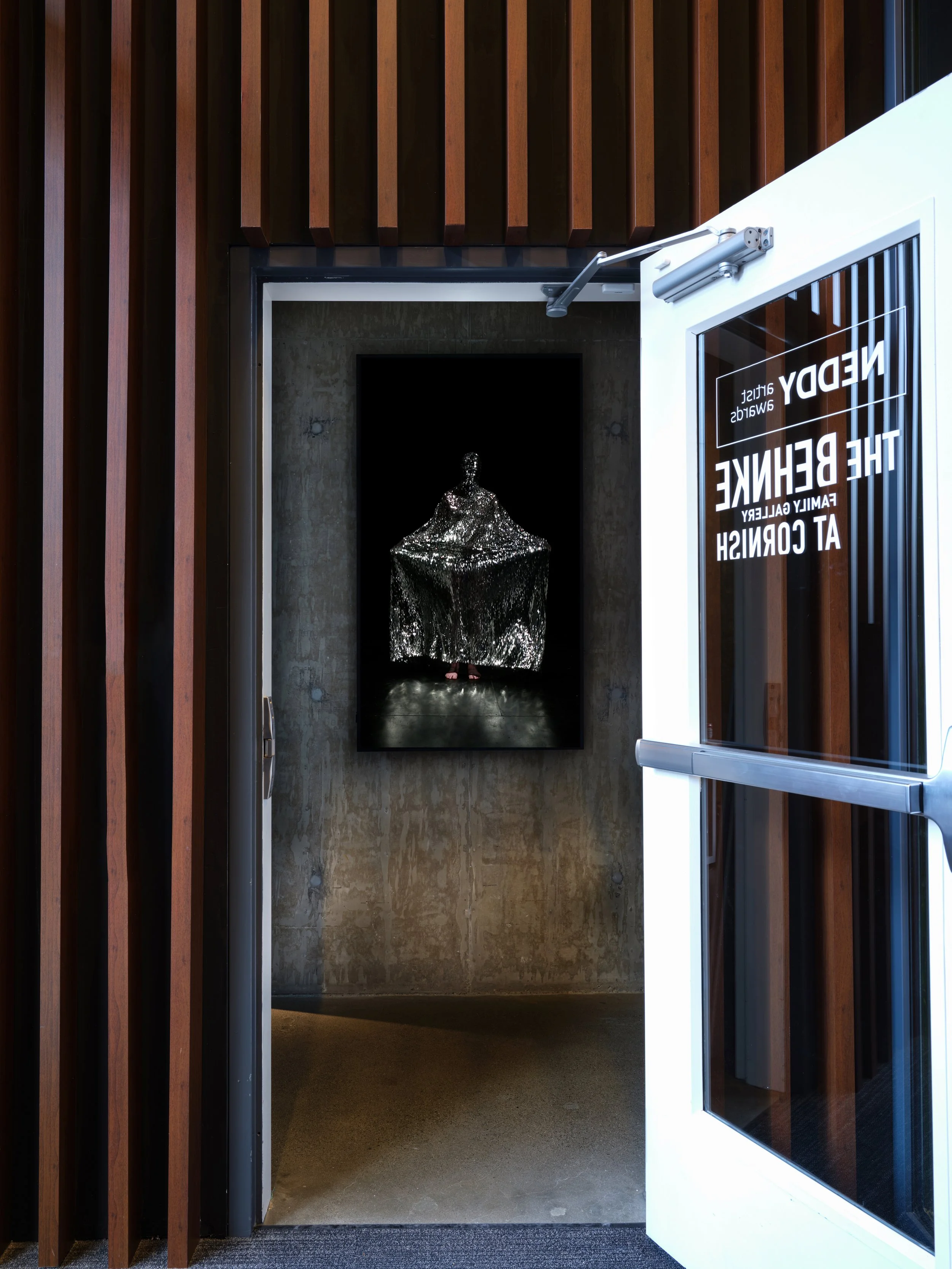
The Seeker (Priestly).Erin Elyse Burns. Single Channel Video 2 minutes, 27 seconds. 2026. Image by Stefan Gonzales, edited by Burns.
The first time I see this work I am at a bi-weekly SOIL Artist-Run Gallery member meeting—Burns and I are members, and she has become a dear friend of mine through SOIL. Walking into Dead Reckoning I am greeted by a flatscreen, which I find out that night is actually suspended from the ceiling — the first time an exhibiting artist has utilized that side of the column in the gallery, and I’m pleased she did. The work on the screen is titled, The Seeker (Priestly). It features a figure, who I know is Burns, shrouded in a wonderfully disco-ball-like garment made by Jessica Munoz-Palomo. This reflective character welcomes the visitors of the gallery with continuous arm gestures, opening out wide and conducting Hail Mary’s. The scene is like a black-box theatre, an immediate reference to a space of performance. There are some lo-fi camera tricks simulating weather; I find out on this night Burns uses dry-ice to create the illusion of rapidly passing clouds. It sets a tone that is spiritual, mysterious and playful. These are characteristics of some of the scenes of videos just on the other side of the girthy cement column, just in a more serious way.
The Seeker (Priest) is what is just on the other side of that column, back to back with The Seeker (Priestly). It faces The Navigator.
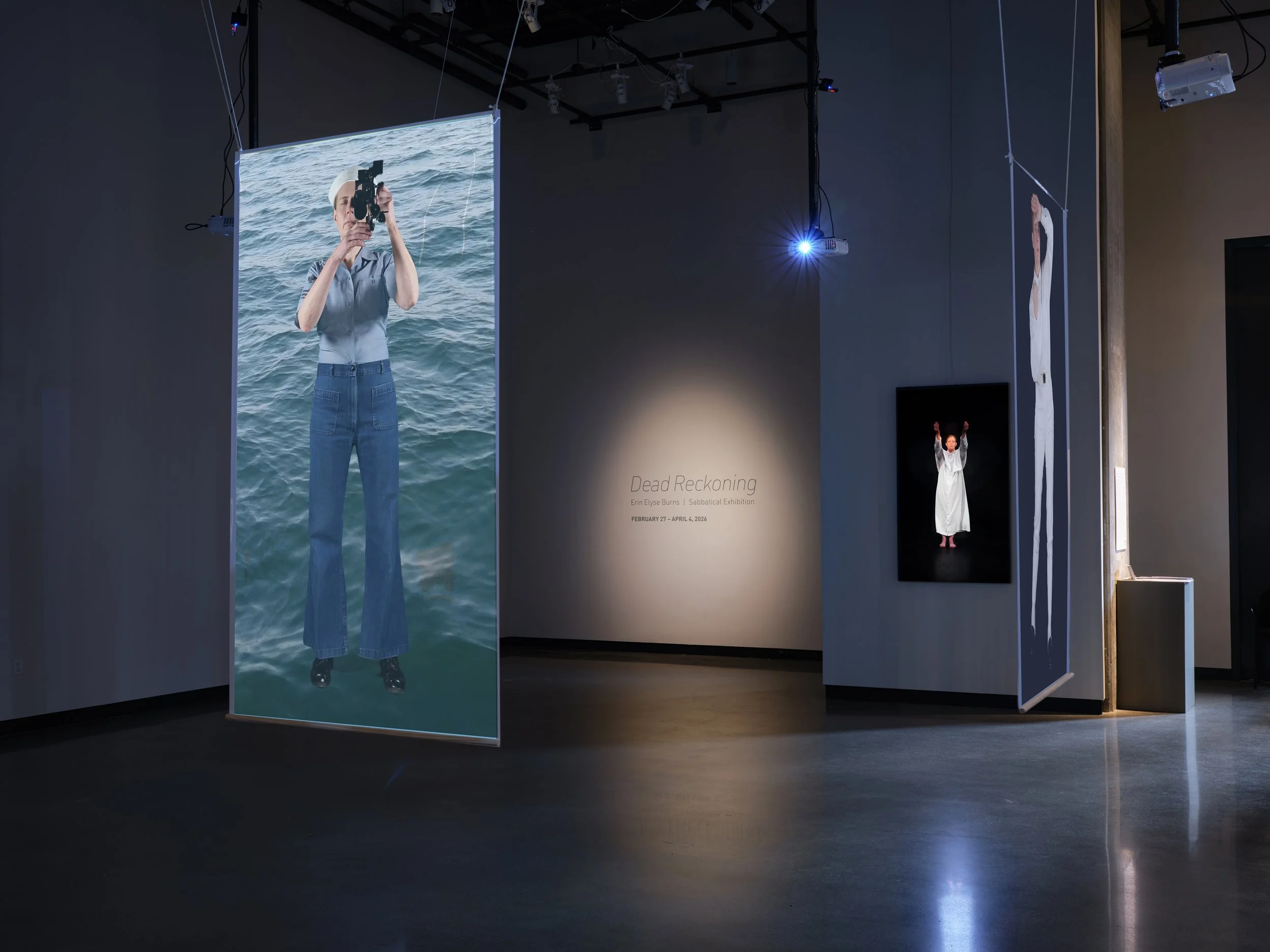
Installation Image by Stefan Gonzales, edited by Burns.
EEB: “I wear the working uniform of a Combat Information Officer, which is a role my father filled in the Navy during the Vietnam War. I hold my father’s sextant in my hands - an instrument of war and navigation. To perform a ‘dead reckoning’ with a sextant is to use the horizon on the open ocean, to set a fix, to draw a perfect sight, to orient without the aid of GPS. This is language I’ve heard my father use throughout his life, his career spent at sea.”
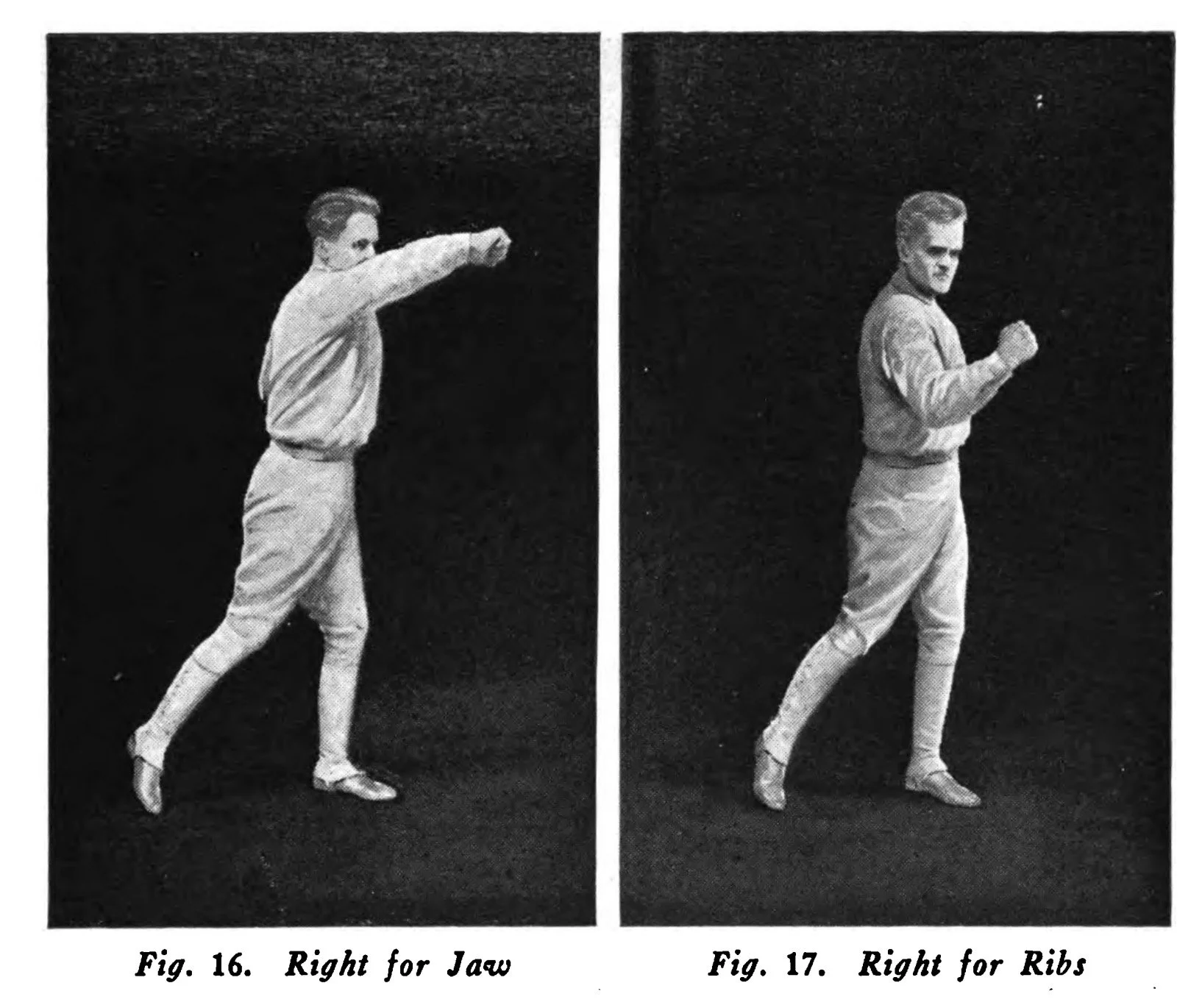
Images from Marshall Stillman’s 1920: Shadow Boxing - How to Train And Advice on Living, Rules of the Ring. Provided by the artist.
The word “dead” as it refers to the use of the sextant derives from “deduced.” Here, Dead Reckoning takes on dual meaning as Burns unravels the narrative of her familial history, The Navigator in the center. There is also The Constable and The Fighter, each character represented by Burns, trapped in their own void-like space on a projector screen hung above eye-level at a life-like scale. They specifically reference Burns’s paternal past in some way: the four generations of military men in the family, the impact of Catholicism, and in the case of The Fighter, a book called Marshall Stillman’s 1920: Shadow Boxing - How to Train And Advice on Living, Rules of the Ring. I became a bit fixated about the whiteness of the outfit on The Fighter, which Burns says is simply a replication of the outfits in the popular boxing manual of the era when her Grandfather would have used it. I initially was thinking about the “Whiteness” in terms of race or religious purity. Perceptions of race have changed over time, especially in the context of Irish immigrants, who faced xenophobia in the US until the privilege of the color of their skin allowed them to assimilate into the institutionalized idea of “Whiteness.” Many White artists don’t actively investigate or reckon with this. Even if not the direct reference here, it is underpinning what I see. Her work is quite stoic in its presentation for a process that I imagine elicits such vulnerability and “grief,” as mentioned in an essay by Sharon Arnold that is at the entrance of the gallery.
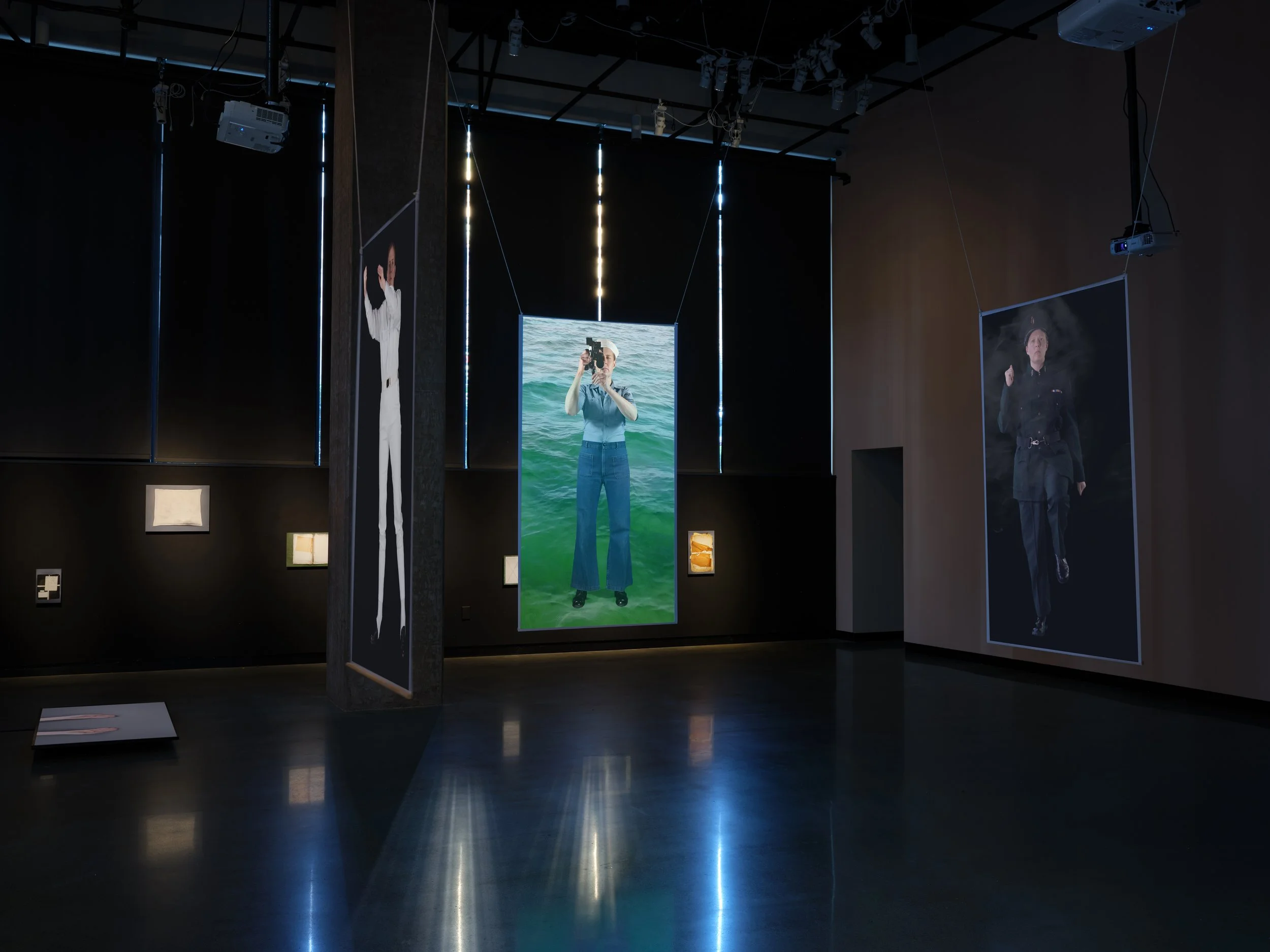
Installation Image by Stefan Gonzales, edited by Burns.
In the back corner of the gallery, as if on its own island, is Safe Handling. It is a choreography of movements of Burns’s hands playing on a monitor, which is lying on its back on the floor. The movements mimic her handling the thousands of files she uncovered in her search of her family’s history, which is documented in the Public Records Office of Northern Ireland. I remember loving the placement of the monitor of the floor in the small backspace of SOIL gallery for her solo show in June of 2025, Tending The Bloodline, which included a few pieces seen on the walls in Dead Reckoning as a part of her ongoing investigation into her lineage. I do think Safe Handling had more impact when it had to be carefully navigated by the viewer. Its placement at SOIL also forced you to squeeze up closer to the wall pieces. In the much larger space of the Behnke Gallery, it feels a bit like a castaway, along with the fourteen photographs of records that easily slip into the background. I’m surprised there isn’t more here.
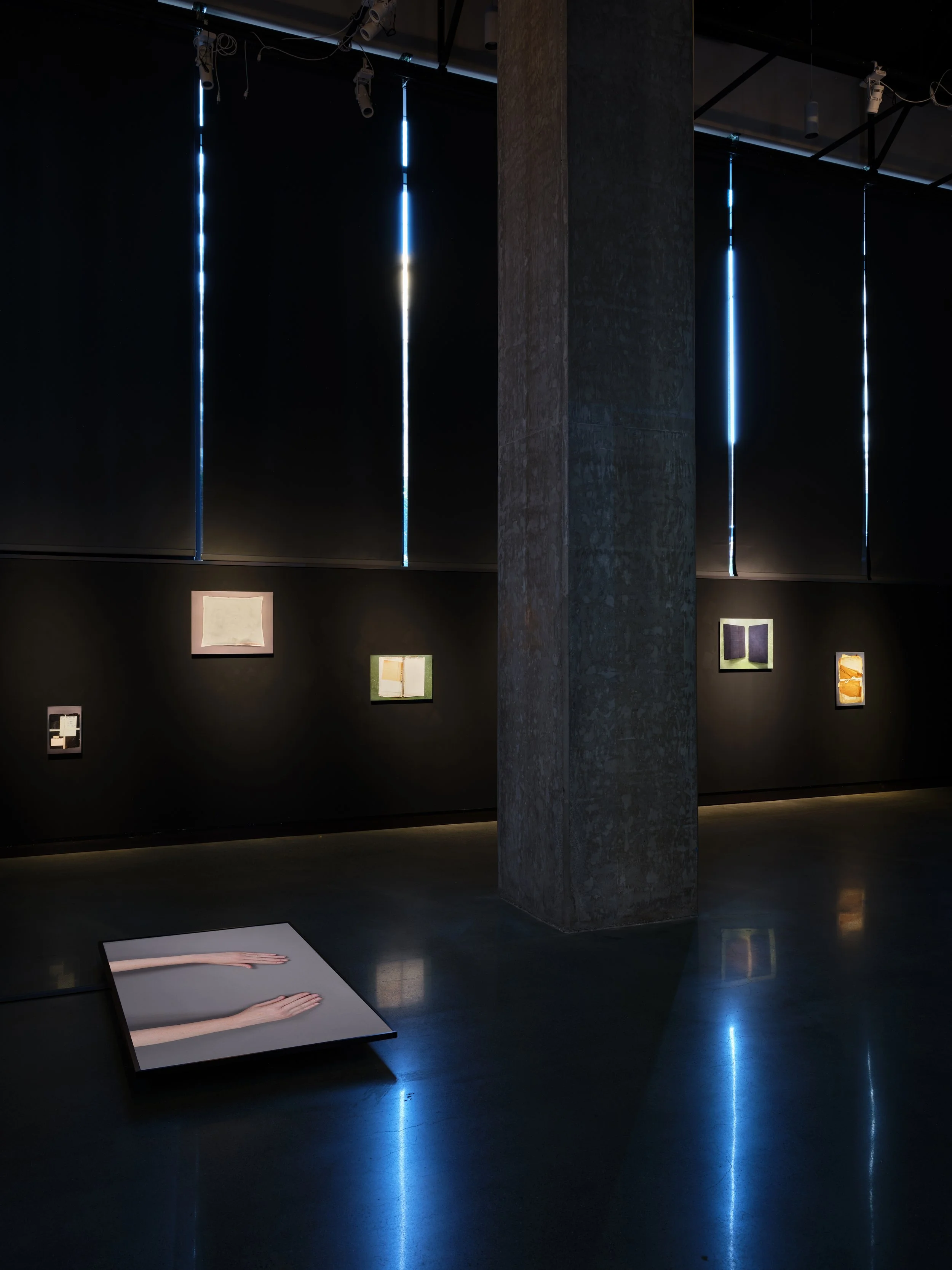
Installation Image by Stefan Gonzales, edited by Burns.
Much of the context of the article is in the form of a multichannel sound installation titled, Yours Faithfully. On repeat it rumbles through the cavernous, high-ceilinged room. A description from the artist of this work:
EEB: “Yours Faithfully voices my grandfather’s prison internment file, which I uncovered while doing research at the Public Records Office of Northern Ireland.* Instead of reciting the paperwork in a documentary form, the sound of four distinct voices intermingle, blend, and build into a chaotic chorus that reflects the language of bureaucracy, administration, incarceration, and immigration. My grandfather’s singular voice rings out amidst the din as he insists upon his release, his innocence.”
**Documents were also referenced from The National Archives in London and the National Archives of Ireland in Dublin.
When I was initially there for the SOIL meeting, it was not quiet enough to experience the sound of the dense and overlapping voices. I went back to the gallery a second time just a few days ago. I wanted to hear these isolated moments more clearly, but it was not as easy to access. As I tried to make sense of all of the voices by reading the transcriptions of each recording provided by the gallery, I felt overwhelmed by the cacophonous chorus. It pushed against the introspection that is at the center of this exhibition and took me back to the trance-like space my head was in watching the repetitive motions of the screens. It did emphasize the disorientation of the mysterious non-linear histories overlapping each other as the artist pieces the parts.
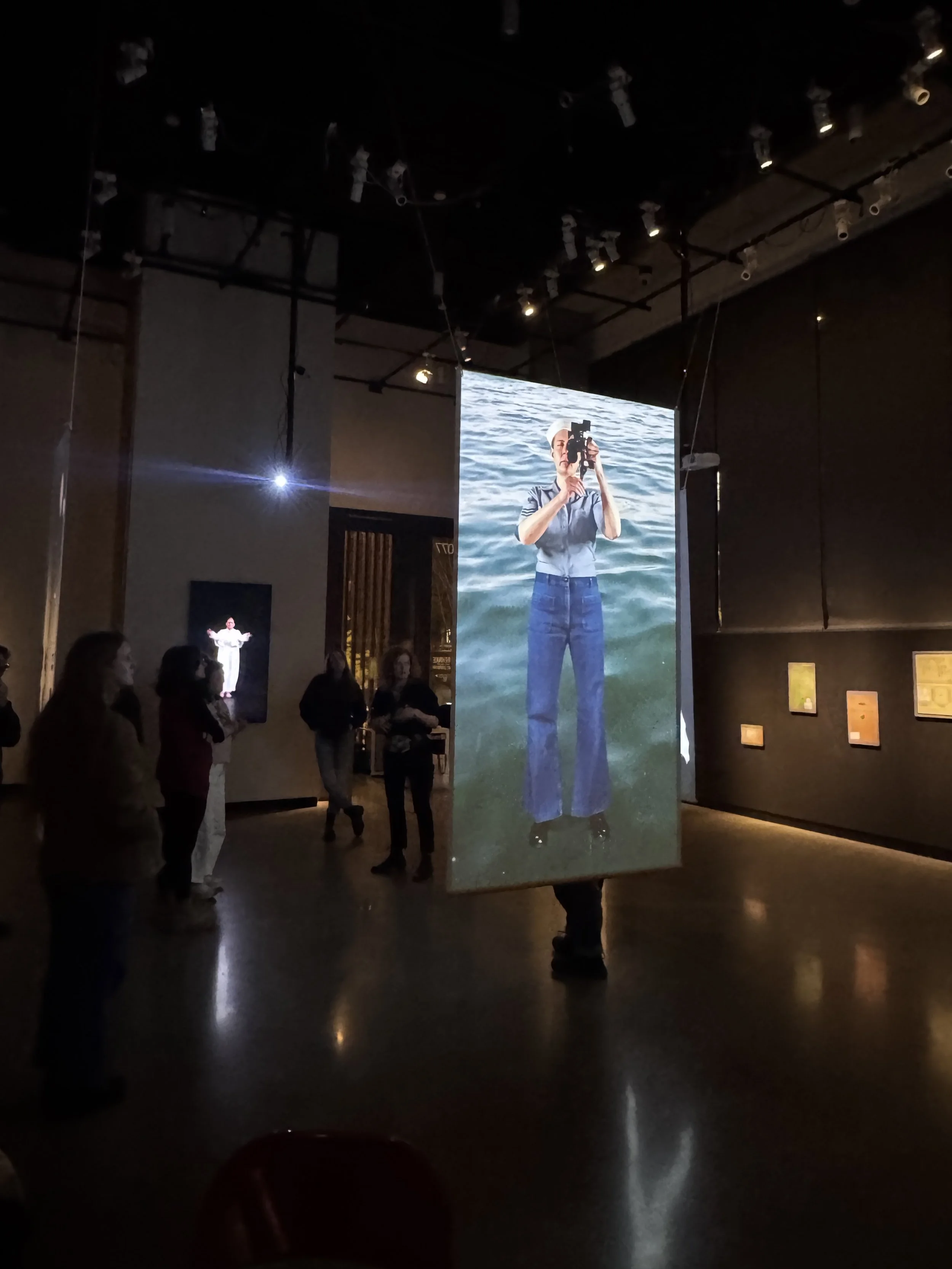
Image provided by the author.
I recognize a detachment happening in the space and in the process, Burns unable to have the exact personal experiences. It’s something we talk about during her brief artist talk at the SOIL meeting. Burns is following the rabbit hole of deciphering the difference between fact and truth. She describes hearing her dad tell stories of her grandfather that seem absurd until she uncovered them herself. I find this detail to be the most compelling of the time I spent in Dead Reckoning.
I had had a conversation with a friend and fellow artist before I went back for the second time, who described the work as being “sterile.” Back in the gallery again, I did agree with that characteristic. Burns very carefully and selectively curated this room that ended up leaving a lot of physical breathing room. Maybe it was what she needed. The carefulness cut out the more visceral experiences I imagine she is having as she imagines her own past to have happened. My intention is not to ask for more traumatic work, that’s not what that world of art needs in a society seemingly begging for traumatic imagery at the expensive of the oppressed. However, there is a unique opportunity for Burns to continue the important reckoning journey, as Sharon Arnold writes it, “contending with the responsibilities of white diasporic peoples seeking to heal the wounds of the past and present, both distant and immediate, in homelands abroad and where we now live.”
Burns graciously answers some questions I have after my initial visit for the SOIL meeting, where many of these thoughts were budding. One response in particular poses a perfect question Burns asks herself in this work.
First, I ask her about a moment I hadn’t taken note of accurately.
JM: There was a comment you made about not being sure if some of the work was fully doing what it needed to…was this in the context of its title, Dead Reckoning?
EEB: I feel 110% about the title. In general I adore the crafting of a show title and feel it taps into my writer’s impulses. I LOVE the title Dead Reckoning and feel zero hesitation about it!… I did talk about hesitation around the religious iconography I used - especially wearing the Catholic priest’s cassock, and acknowledged that the two The Seeker pieces were the hardest for me to make, to commit to showing, because I felt I was tapping into something raw that I don’t fully understand yet.
Another moment I acknowledged as a question [during the meeting] was, can the physical repetition of my movements in the video works (marching, boxing, using the sextant) act as a form of somatic embodiment that helps to release intergenerational trauma? I don’t have a concrete way of gauging that, but I do feel intrinsically that the body knows (often more than the brain) and that making this work has generated healing in tangible and intangible ways.
JM: There was a comment someone else made about “slipping into another identity,” in this exhibition. You seemed hesitant about it. Can you speak about the detachment that you experienced while working on this exhibition and if you would agree that you feel like you are slipping into another’s identity, or not?
EEB: I’m not sure I remember this in the same way, but I did talk about how this work is closer to autobiography than a lot of work I’ve made in the past, and so it walks a more vulnerable line. As an artist who is frequently both in front of and behind the camera, I feel very comfortable slipping in and out of roles, identities, personas, and often describe this as a “second self.” It has to be me because I make this work around experiences I want and need to have, but the work is simultaneously not me. A self extended. By working in this way, a certain psychological distance is necessary for me to be able to perceive myself as a subject, which is something I have a lot of practice in. It’s a different form of conceptual evaluation, say, than taking a selfie. By working closer to my identity, to my family’s history, I have been thinking about how that protective barrier has been a little harder to access in some ways. Still processing that one.
JM: Can you make a brief statement about where this specific line of inquiry for this body of work began?
EEB: This way of working began in 2022 with the piece The Constable, which was the first time I began researching my Irish history and the roles the men on that side of my family filled. This impulse came from a desire to understand the contexts that informed their difficult lives and the harmful actions they were involved in. The impulse came from a desire to heal trauma, to better understand the complexities we humans find ourselves in. After The Constable I developed other “characters” that reference roles the men in my family portrayed, and also began doing archival research online. This led to eventually visiting national archives abroad to continue research there. A lot of this was informed by the desire to think through the nuances of the stories families tell - our myths and half-truths that form identity over time. Memory is a porous thing. What the archives have to offer are factual objects. Yet those objects only tell partial truths. So it brings us to that question of, is fact or fiction more truthful?
How have you been responding further to your work now that it has been materialized in space?
EEB: I can see myself working in this way for a while - this show feels like just the beginning. I want to dig into the matrilineal family line eventually and have already visited regional archives in Germany where other family originate. I have a lot of material from those trips waiting for my attention!
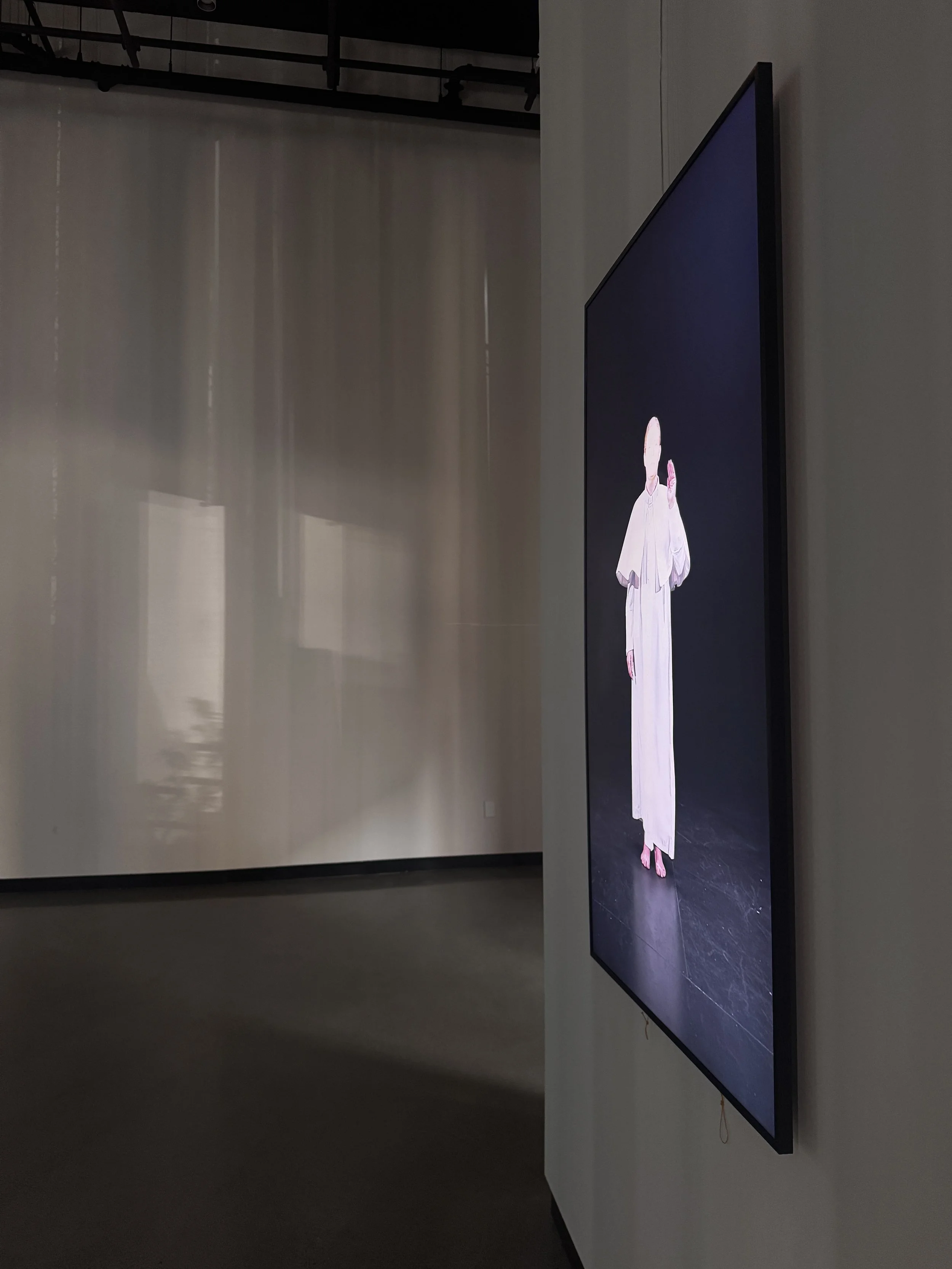
Image provided by the author.
Dead Reckoning is an exhibition of a massive amount of physical information, passed time, and complex emotions condensed into this tight curation. How do you address the holes in memory that aren’t even your own? I can see the gaps of her own history up against the portions of truths Burns reenacts and imagines. The gaps will continue to be confronted in this ongoing endeavour. Of course, the plentiful text present in the gallery provided by the artist and Sharon Arnold’s essay assisted me in filling in the gaps I was experiencing myself. I like hearing this is just the beginning. I’ll be anticipating how this inquiry expands over time and the space it fills out.
Special thanks to Erin for all the thoughts she put in my brain and new intentions to be curious and open, pouring out what I put into myself.