


Created: April 30, 2026 at 5:37 PM
Recap: Holly Ballard Martz & Barbara Earl Thomas Convo
NOTE TO SELF: Look up “the eye” Seattle.
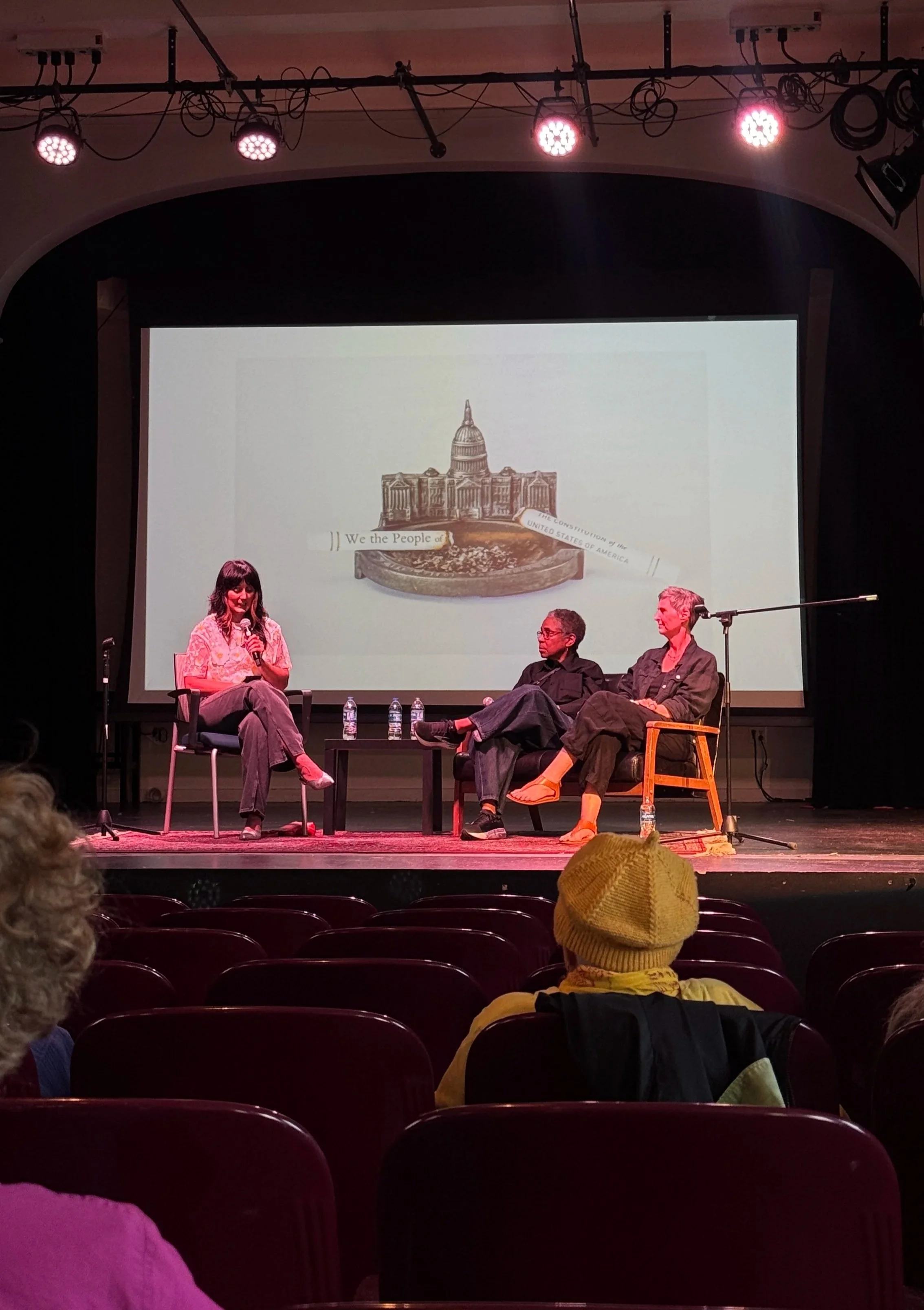
Casey Arguelles Gregory, assistant curator with The Lumiere Group and moderator for the conversation, introduces herself as having run “The Eye.” Later I dig online and find the website isn’t up but the instagram is: @theeyeseattle “Discovering the Pacific Northwest through its Visual Art” the bio reads.
Anyways, the first question she asked the artists I didn’t specifically jot down — abbreviated, she asked how they consider their audiences in their work.
Barbara says she doesn’t think about the audience — not in the same way she thinks about herself as a storyteller. She asks, “how do I seduce them to give me their attention?” She doesn’t know if she is looking for a particular human, but knows what she responds to, and how she might share a cord with the hypothesized viewer.
Her answer is quite elegant and contemplated, Holly responds “ditto” and audience laughs in agreement. Martz does go on to say she is making impulsively and from her own world — something extremely relatable. She expresses she hopes to connect with even one person — also extremely relatable. Making work about mental health fifteen years ago, her focus was making from some deep part of herself. I respect this about both of the artists, I don’t consciously think of some deep part of myself in my current practice of glueing foam together—I feel like I still am searching to understand something in the material and don’t contextualize it to my world beyond the aesthetics I am attracted to.
Martz’s focus on herself made a difference — she found she could connect to people more by making work about her own child, who was struggling with “debilitating depression.” She mentions at the time in which she was making this work mental health wasn’t spoken of how it is today.
Thomas shares she has had plenty of experiences of “lurking” at her own shows and listening to people “make up stuff.” she has a charm that also makes the whole room laugh alongside her; plus her choice of words. She acknowledges that, yes, artists’ works frequently become generalized so viewers have a way in to the work. There is a consensus that that really shows the arts success, if success is measured by a large volume of people investing interpretation into an artist’s work.
The conversation evolves into discussing how work specifically is accessed in the public.
Martz expresses she is a public art novice — feels her work is not palatable for the public because of its political-ness. Later I look further into her work history and see the way she has publicly intervened with her art that I would call public art. And the work is all quite political. She admits she had to change her work a bit for her first venture into public art for the Port of Seattle. I don’t quite know—or maybe don’t remember what her plans change from and to, yet I think of how Maikoiyo Alley-Barnes has had work up for the past six months titled WAIT! WAIT! DON’T SHOOT! (an incantation for Trayvon and Jazz), 2014. The title was unsurprisingly under a kind of scrutiny that could have led to editing and censorship, luckily its ultimate importance to make an impact to those who pay attention to it was greater than the scrutiny.
Back to Martz, a large factor playing into change as well for her is that the work needs to be sturdier, so she is casting a bronze sculpture for the first time. I couldn’t help but think, “Me next!”
Thomas points to a shift in public art in the 80s away from the restrictive category of sculpture. This reinforces my later thoughts of Martz public interventions with her art being a form of public art in a nuanced definition. Thomas has thought of her work being bigger even if she was trained two dimensionally. This parallels my own creative practice. She describes herself as a person that makes things and sometimes she makes it more public should a project be in line with what her work seeks to share.
These are truly my favorite and most helpful snippets of the talk, which came at the end:
There are two kinds of writers — who have the story and who find the story
Sometimes it takes a year and a half to have a break through
Holly has a 23 foot tall project she couldn’t see until it was in the space — studio is not the size to adequately visualize it: and that’s a nice surprise to have. Research being surprising many time too — like naturally floating material
“ People are looking for ways to shape their thoughts in what is going on “ Barbara. She is committed to brings people from all parts of this human spectrum to ask what something is together. “How do we pace ourselves to be present” Barbara.
Also in this conversation, on the stage it is decided: Everything is political.
Art impacting the moment of the viewer is the question— Holly says one impact is enough.
Barbara points out that we think a lot about ourselves for being such small players. She taught young people — if you encounter a human, you are encountering the whole world they experienced up until the moment of meeting.